My family died in Ukraine. My mum blamed Zelensky’s troops – the truth is complicated
 5 min read
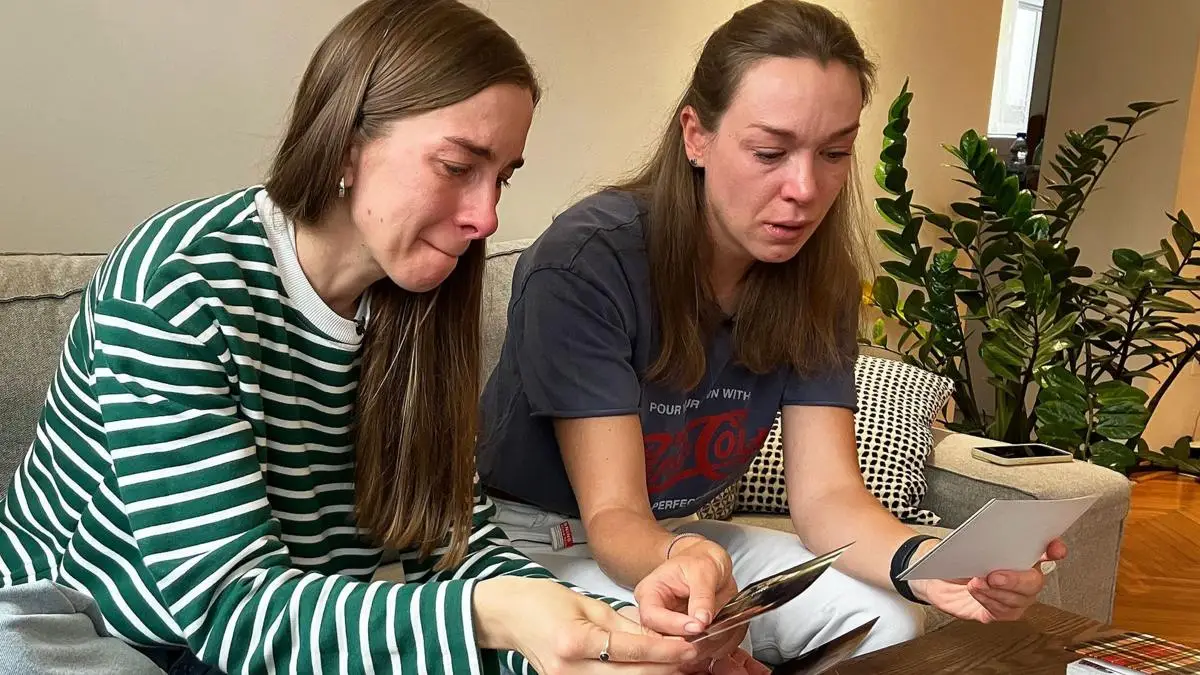
I am sitting on my balcony in Kyiv looking at a photo of a garden in the village I grew up in, in eastern Ukraine. The plot is overgrown with thick grass, and two wooden stakes are planted in the ground. Despite the warm sunshine, I find myself shivering.
The woman who sent me the photo says the stakes mark the graves of my grandparents, killed as the Ukrainian-Russian front line reached our little community. Not far away, in another garden in the village, the body of my father, Serezha, is buried in a greenhouse.
I cover the Russia-Ukraine war for the BBC World Service, but found myself in the middle of that story in February last year when my mother sent me a devastating text message.
"Granny, grandad and Serezha are gone. Now there is no-one left," it said.
Because not only had I lost three beloved family members, my mother blamed Ukraine for their deaths – the country where I was born and have lived for most of my life.
Mum was born in Siberia. From the moment Moscow launched its full-scale invasion of Ukraine in February 2022, she had supported Russia in the conflict.
Backing Moscow is not that unusual in the Donbas region – the predominantly Russian-speaking part of eastern Ukraine where my village Dachne is located.
After pro-Russian forces captured large parts of the Donbas in 2014, many of those who stayed supported Moscow over Kyiv, a stance cemented by exposure to Russian state TV.
Now the Russians occupy almost 80% of Donetsk – the part of the Donbas where my village is. Over the past nearly five years, since Russia's full-scale invasion, entire towns and cities have been razed to the ground, external.
I had already fallen out with my sister Sasha, who had been living in Moscow with her young family when the war broke out. She refused to take sides – I felt hurt and cut her off.
But earlier this year, around the first anniversary of Dad's death, Sasha unexpectedly texted me. We started talking over text about our childhood – the way things used to be. I realised I was not angry with her anymore. She too was grieving, missing Dad just as much as I was.
I told her I wanted to make a documentary about Dad and she was very supportive. I knew then that I had an ally on my journey. But we decided not to tell our mum just yet.
I started looking for witnesses to the events in Dachne that took place in January 2025, the month Dad is believed to have been killed. It was not easy. It was a village of a few hundred people, but many had left, others had died, and those who remained had limited phone signals.
Russia publicly announced the capture of Dachne on 14 February and it has remained under Moscow's control ever since.
This meant it was impossible for me to travel there in person. So I began trying to contact my family's neighbours.
In a Dachne village messaging chat, I found the number of a man I'll call Misha. I was told he had been with my father on the day he died. Speaking to the BBC could put him in danger with the Russian occupiers, so I did not tell him I worked for the BBC or that I was recording our call.
Misha told me that on 26 January he had looked in on my father and realised he had been injured. Serezha told him he had been "clipped" by a drone, and had asked Misha to bring a first aid kit, he said.
It is impossible to know which side was operating the drone that killed my father, but we do know that Russian drones were constantly targeting the village at that time.
"I asked if the wound was serious. He [Serezha] said it wasn't," said Misha – but then recalling how, when he had returned to check on my father a couple of hours later, he had found him dead.
With the help of two other villagers, Misha said they had buried him in the greenhouse.
"I'm sorry I couldn't save him," Misha told me.
BBC Eye Investigations: Who Killed My Family?
BBC journalist Anastasiya Gribanova investigates who killed her father and grandparents in Ukraine, uncovering painful accounts as she tries to reunite her divided family.
Watch on BBC iPlayer or listen on BBC Sounds now (UK only)
If you are outside of the UK, listen to the Who killed my family podcast here
As for my grandparents, my investigations suggested the events surrounding their deaths may have been more complicated.
Their house, on the eastern side of Dachne, had been destroyed. Neighbours told me they had escaped to another home on the same street.
I eventually reached a woman I'll call Lina, who lived nearby and was the last person, as far as I know, who saw my grandparents alive.
She could not recall what this date was, but knew it was in the second half of January.
At this time, she said, "the Russians were fully advancing – the edges of the village were being shelled. Then the Ukrainian soldiers moved from the edge of the village into the centre. They hid in people's yards and used side streets to avoid drones."
She said two soldiers entered her property. They had not been wearing any identifying insignia but had been speaking Ukrainian, she said – a language that Lina described as "Bandera", a derogatory term for Ukrainians.
"You're going to have to leave. Why are you still here?" Lina said they had asked her.
She said one had pointed a machine gun at her as she had stood outside her house, while another had gone to see my grandparents. She told me she had feared for her life and then fled her house for the night.
The following day, she told me she had returned to my grandparents' street to check on them.
She had found the door to the house they had been staying in open, she said, despite the freezing conditions.
With drones buzzing overhead, Lina said she had not dared look inside, but had later heard from neighbours that my grandparents had been found dead. She believed it had been the Ukrainian soldiers who visited her house who had shot them.
Another neighbour, who I will call Maria, described discovering their bodies – my grandmother in bed, covered in a blanket, and my grandfather lying on the floor in a pool of now-dried blood.
Maria also believed Ukrainian soldiers had killed them – because, she said, that she too had felt threatened by Ukrainian troops at the time.
"If they had seen me they would have killed me too."
Her theory was that my grandparents had irritated the troops in some way.