Shot in the face at 15: The lives shattered by Cameroon’s decade of conflict
 3 min read
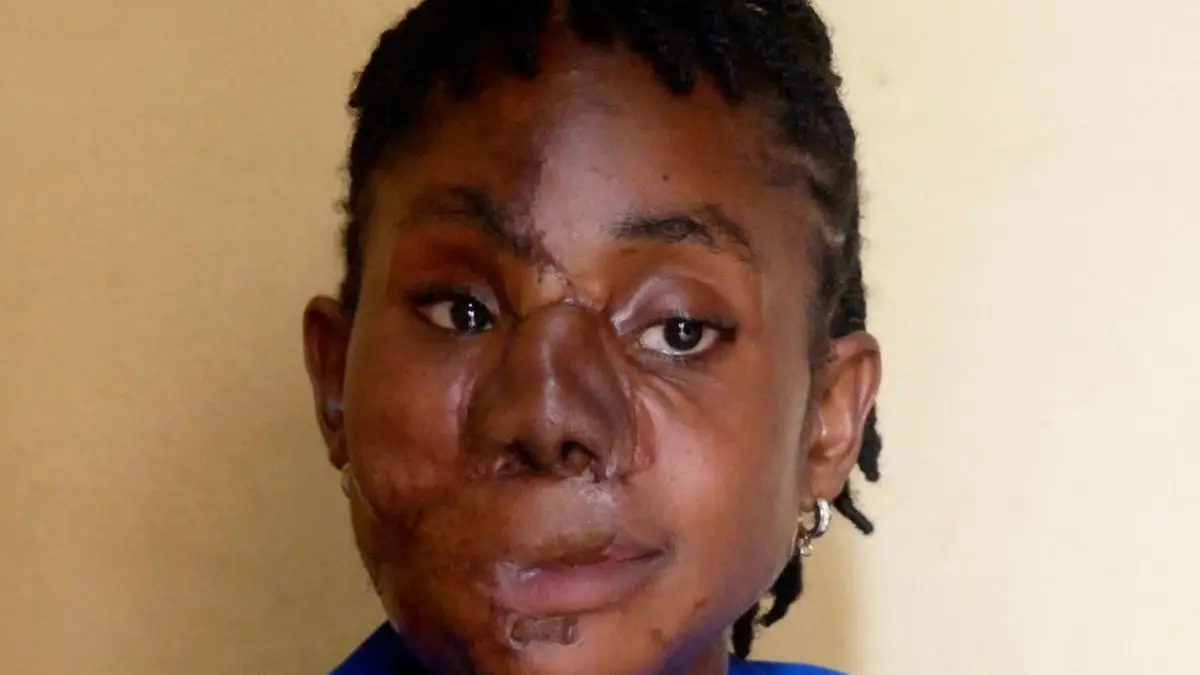
Median Bah was just 15 when her life changed forever.
She remembers the date vividly – 7 April 2018. She was ill and confined to her bed.
Armed men stormed her family's compound in Cameroon's Southwest region, one of the country's two English-speaking areas at the centre of a separatist conflict.
Median, now 23, says she was fast asleep when her brother woke her, panicked by the approach of a group of armed men who were shooting indiscriminately.
He escaped through a window. But for Median, fleeing was not so easy.
"Since I was sick, I had no strength to jump through the window with him, so I had to pass through the door," she tells the BBC.
That decision would have devastating consequences.
She says she came face to face with two of the attackers in the backyard, who opened fire at her.
They first shot her in the thigh before firing several more rounds, which severely damaged her face.
"I kept pleading with them not to kill me, that I wasn't feeling well. However, I found myself on the floor," she recalls.
Everything went dark. She lost consciousness and could neither see nor speak.
The attack left her with devastating facial injuries. Her jawbone was damaged, most of her teeth destroyed and much of her mouth severely injured.
Over the past eight years, she has undergone at least four reconstructive surgeries in Cameroon, Ghana and India, with more procedures expected next year.
Parts of her face have been reconstructed using tissue taken from other parts of her body.
She also lost the ability to breathe normally through her nose and mouth. She underwent a tracheostomy, a surgical procedure that creates an opening in the neck to allow air into the windpipe.
For eight years, she relied on a tube to breathe. It was only recently removed, allowing her to breathe normally again.
A teenager left with devastating facial injuries, a mother forced to flee her home and a student whose education was disrupted. Nearly a decade of fighting in Cameroon has left countless lives shattered.
The crisis began in October 2016, when lawyers and teachers in Cameroon's English-speaking regions went on strike over the alleged marginalisation of Anglophone communities by the Francophone-dominated government.
They were concerned about the appointment of French-speaking judges and teachers to courts and schools in the English-speaking Northwest and Southwest regions.
Initially, the protest was peaceful, with thousands demanding greater recognition of the English-speaking minority.
But human rights groups accused security forces of using excessive force to suppress the protests. The crackdown, critics say, helped fuel an armed separatist movement.
Since then, separatist fighters have engaged in a prolonged and often brutal conflict with government forces.
Rights groups have documented serious abuses by both sides.
Separatist fighters have been accused of targeted killings, kidnappings for ransom, torture and attacks on schools and other public and private facilities.
Government forces, meanwhile, have faced allegations of arbitrary arrests and detention, torture and unlawful killings.
Both sides have denied the accusations, although in some instances they have acknowledged responsibility for abuses.
The violence has devastated communities and forced half a million people from their homes, according to data published by the UN this year.
At least 6,000 people have been killed since the conflict began, according to Human Rights Watch.
The UN refugee agency, UNHCR, says more than 70,000 Cameroonians have sought refuge in neighbouring Nigeria.
Glory Akom, 44, lives with a disability after surviving severe burns in an incident unrelated to the conflict.
The mother-of-two now lives in a camp in Ogoja, a town in Nigeria's south-eastern Cross River state, near the Cameroonian border.
Ogoja hosts about 15,000 refugees across three settlements, Richard Effiong, from the UNHCR, told the BBC.
The UNHCR has provided refugees with brick houses topped with tin roofs.
For many, however, uncertainty remains over when, or whether, they will ever return home.
Glory says her life in Cameroon was far better. She ran a business and was able to provide for her family.
But everything changed when fighting intensified in 2017.
She said soldiers deployed to her area in the Southwest region pursued residents into the bush, forcing them to abandon their homes and flee into Nigeria.
"We were sleeping in the bush, as we were always running," she said.
"If you slept in your house, they could kill you there."
Initially, she settled in a neighbouring village before moving to Ogoja, where she was eventually allocated a permanent home.